
Balinese Dance and Gamelan: An Australian Traveller’s Guide
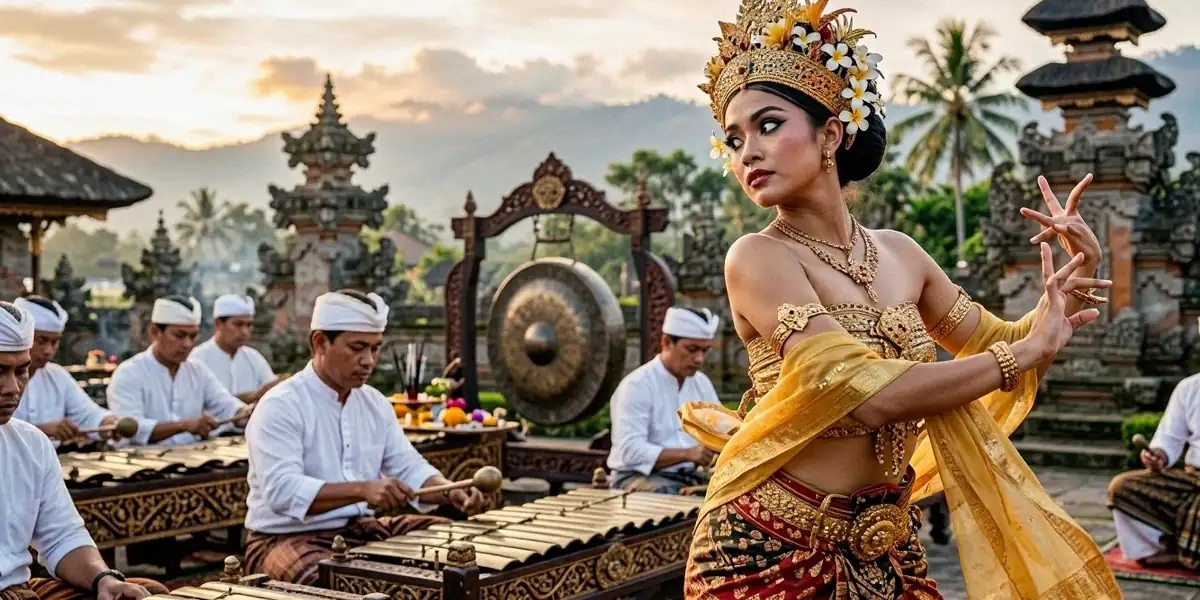
I still remember the moment the gamelan hit me. It was a humid Tuesday night in Ubud, maybe 2019, and our team had wandered into a courtyard off Jalan Raya after a long day of rice terrace walks and too much iced coffee. We were hot, tired, and honestly a bit sceptical about “cultural shows.” Then the first gong struck — this deep, shimmering wave that seemed to come up through the concrete — and about forty metallophones kicked in behind it, all hammering these impossibly fast interlocking patterns. Nobody spoke. Nobody checked their phone. For the next hour we just sat there, completely pinned to our plastic chairs, watching a Legong dancer move her wrists in ways that shouldn’t be anatomically possible.
That night changed how we travel through Bali. Since then, our team has been back more times than we can count — Seminyak for the beach, Canggu for the cafés, but always at least one night in Ubud or down at Uluwatu for the dance. This guide is the practical, opinionated version of everything we’ve learned. It’s written for Australians specifically: how to get there from your hotel, what tickets actually cost, what to wear, what to expect, and — most importantly — why Balinese dance and gamelan are worth planning a whole evening around. If you’re heading to Bali and you’ve never seen a Kecak fire dance or heard a real gamelan ensemble live, this is your starting point.
What Is Balinese Dance? A Quick Cultural Primer
Balinese dance isn’t a folkloric side-show put on for tourists. It’s a living, breathing religious practice that’s been woven into Balinese Hindu life for centuries, and it’s still performed at temple ceremonies, cremations, and village festivals across the island every single week. If you understand that going in, every performance you see — even the ones staged for visitors — will hit differently.
The tradition draws on Hindu-Javanese roots going back to the Majapahit empire, which fled Java for Bali in the 15th and 16th centuries and brought with it a courtly, ritualised performance culture. Over time, Balinese artists made it their own: sharper, more athletic, more percussive, and far more closely tied to the temple than to the palace. Today, dance and gamelan are inseparable in Bali. You almost never see one without the other. The dancers move to the gamelan, the gamelan responds to the dancers, and the whole thing functions as a kind of conversation between the performers and the spirit world.
For Australian travellers, this matters for a simple reason: Bali is only a 6-7 hour flight from Perth, Melbourne, Sydney, or Brisbane, and it’s one of the closest places on earth where you can witness a genuine, unbroken classical performance tradition. You don’t need to fly to Japan or India to see something ancient. It’s right there, two Bintangs away from your hotel pool.
The Spiritual Role of Dance in Bali
In Bali, dance is an offering. That’s the first thing to understand. Dances are performed at temple ceremonies known as odalan — the anniversary of a temple’s consecration, which happens every 210 days on the Pawukon calendar. They’re also performed at cremations, at purification rituals, and at life-cycle ceremonies. The performers aren’t entertainers in the Western sense; they’re participants in a religious event, and their performance is considered a form of devotion.
Many dances were originally sacred — meaning they could only be performed inside the temple, in front of the gods, and not for casual audiences. Some still are. The Sanghyang Dedari, for example, involves young girls who are believed to be entered by spirits and dance in a trance state. The Barong mask itself is considered a sacred object, kept in a temple and treated with real reverence. When you see a Barong performance in a tourist venue, you’re seeing a version of something that, in its original context, is genuinely holy.
That doesn’t make the tourist performances fake. It just means they’re one layer of a much deeper tradition. Our advice: see both. See a staged performance so you can actually watch what’s happening without worrying about ceremony etiquette. Then, if you get the chance, attend a temple ceremony and watch how the same movements feel in their proper context. The difference is enormous.
How Balinese Dance Differs from Other Asian Traditions
If you’ve seen Thai classical dance, Japanese kabuki, or Indian Bharatanatyam, you’ll notice Balinese dance is its own thing entirely. A few of the biggest differences:
- It’s percussive, not melodic. Where Indian classical dance is often structured around sung melodies and specific ragas, Balinese dance is driven by the gamelan’s rhythmic cycles. The dancers’ movements sync to the drums and metallophones in a way that feels closer to jazz than to opera.
- The eyes matter. Balinese dancers train their seledet — the quick darting of the eyes — for years. Watch a Legong dancer’s face and you’ll see the eyes flick left, right, up, down in sharp punctuation with the music.
- It’s athletic and grounded. Thai dance floats; Balinese dance digs into the floor. Dancers are almost always half-squatted, feet flexed, knees bent, weight low. It’s physically demanding in a way that surprises first-timers.
- It’s ensemble-based. Unlike traditions that showcase solo stars, Balinese dance is usually a group form — a dozen or more dancers moving in tight coordination, backed by a full gamelan orchestra of 20-40 musicians.
- It’s still evolving. New dances are created every year, especially at the Bali Arts Festival. This isn’t a museum tradition; it’s a living one.
When and Where Dances Are Performed
Timing in Bali is governed by two calendars running at once: the Saka calendar (a lunar Hindu calendar, similar to the one used in India) and the Pawukon calendar (a 210-day cycle unique to Bali). Temple ceremonies, and therefore many dance performances, are scheduled according to these cycles — not the Gregorian calendar you’ve got on your phone.
Practically speaking, that means:
- Temple ceremonies (odalan) happen throughout the year, on different dates for different temples. Ask your hotel or a local guide what’s on during your stay.
- Tourist performances run on fixed schedules — usually nightly in Ubud, and at sunset at Uluwatu and Tanah Lot.
- The Bali Arts Festival runs every June and July in Denpasar, with performances every day.
- Full moon and new moon nights (Purnama and Tilem) are considered auspicious and often feature ceremonies.
If you’re in Bali for a week, you’ll almost certainly have a chance to see something. If you’re there during an odalan at a major temple, drop everything and go — that’s the real Bali.
The Big Four: Legong, Kecak, Barong, and Gamelan
There are dozens of dance and music forms in Bali, but four dominate the traveller experience: Legong, Kecak, Barong, and gamelan. If you only see one thing, see one of these. If you see two, see a Legong and a Kecak. If you see all four, you’ll walk away with a genuine understanding of what Balinese performance is about.
Legong: The Refined Dance of Royal Courts
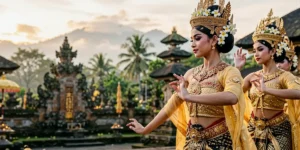
Legong is the classical dance most visitors picture when they imagine “Balinese dance.” It’s performed by young girls — traditionally pre-pubescent, though today often teenagers — in tight gold costumes with elaborate headdresses, and it’s characterised by incredibly precise, refined movement: trembling fingers, darting eyes, sharp head turns, and a constant low, bent-knee stance.
The form originated in the royal courts of Bali, particularly in and around Peliatan and Ubud, where it was performed for kings and their guests. The most famous version is Legong Keraton, which tells the story of a king who kidnaps a princess and is then killed in battle — a condensed, symbolic narrative told almost entirely through gesture. There’s no dialogue. There’s no singing. Just the dancers, the gamelan, and the story.
Legong is short — usually 15-20 minutes — and it’s often paired with other pieces in a longer programme. The best place to see it is at Ubud Palace (Puri Saren Agung), which hosts nightly performances right in the centre of town. Tickets are cheap, the setting is atmospheric, and the quality is consistently high. Get there early for a front-row seat.
Kecak: The Hypnotic Monkey Chant
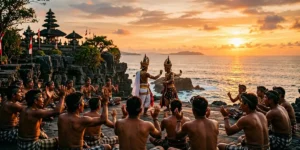
Kecak is the one that surprises people. Instead of a gamelan orchestra, the music is provided by a chorus of 50-100 men, sitting in concentric circles, chanting “cak-cak-cak” in interlocking rhythms that build into something genuinely trance-like. There’s no instrumentation at all — just human voices, in layers, for up to an hour.
The form is surprisingly modern. It was developed in the 1930s in the village of Bona, Gianyar, by a dancer named Wayan Limbak working with German painter Walter Spies. It draws on the Sanghyang trance ritual — where men chant in a circle to induce a trance state — but was adapted into a dramatic performance based on the Ramayana epic. The most famous scene is the burning of Lanka, where the monkey army (the chorus) helps Rama rescue Sita from the demon king Ravana.
The Kecak is performed in many places, but the most spectacular is at Uluwatu Temple, where it’s staged at sunset on a clifftop overlooking the Indian Ocean. The combination of the chanting, the fire, the sunset, and the 70-metre drop behind the performers is genuinely unforgettable. Book ahead — it sells out in high season.
Barong and Rangda: The Eternal Battle
Barong is the lion-like creature — a huge, shaggy, masked figure with a long body operated by two dancers — who represents the forces of good in Balinese cosmology. Rangda is the demon queen, with bulging eyes, a long tongue, and a terrifying presence, who represents chaos and destruction. Their confrontation is the heart of a dance-drama called Calonarang, which is performed all over Bali.
The story is essentially a battle between good and evil that never resolves. Barong and Rangda fight, the keris dancers (men in trances who stab themselves with daggers) enter the fray, and the whole thing ends in a state of ambiguous balance. This is the Balinese Hindu worldview in a single performance: good and evil are not opposites to be defeated, but forces that must be held in tension.
The best place to see a Barong performance is Batubulan village, just north of Denpasar, where performances run daily. It’s a short drive from Sanur or Ubud and a popular stop on day tours. The performance is around an hour and is genuinely dramatic — especially when the trance dancers get going.
Gamelan: The Sound of Bali
Gamelan is the orchestra itself — the bronze-keyed metallophones, gongs, drums, and flutes that provide the music for every dance. In Bali, gamelan is not background music; it’s the engine of the performance. The dancers follow the gamelan, and the gamelan responds to the dancers. They’re one thing.
There are dozens of different gamelan ensembles in Bali, each with a slightly different tuning, repertoire, and social function. The most popular today is Gong Kebyar — a style that emerged in the early 20th century and is known for its explosive dynamics, sudden tempo changes, and virtuosic interlocking patterns. If you see a gamelan performance in a tourist venue, it’s almost certainly a Gong Kebyar ensemble.
Other important ensembles include:
- Gamelan Semar Pegulingan — a softer, more melodic court gamelan, often used for Legong.
- Gamelan Gong Gede — a large, older-style ensemble used for temple ceremonies.
- Gamelan Angklung — a smaller ensemble associated with cremation rituals and processions.
- Gamelan Jegog — a dramatic bamboo gamelan from West Bali, with huge bamboo tubes instead of bronze.
You’ll hear gamelan everywhere in Bali — in hotel lobbies, at ceremonies, drifting out of village halls at night. Once you’ve heard it live a few times, you’ll start recognising the different styles.
Where to See Balinese Dance in Bali (Our Top Picks)
Bali is small enough that you can see a performance from almost anywhere on the island, but some venues are much better than others. Here’s where our team actually goes — and why.
Ubud: The Cultural Heart
Ubud is the obvious starting point, and for good reason. It’s the island’s cultural capital, packed with dance schools, gamelan groups, and nightly performances. If you’re staying in Seminyak or Canggu, Ubud is a 1.5-2 hour drive (depending on traffic — always depending on traffic), which makes it a long day trip but a doable one. Many Australians base in Ubud for two or three nights specifically to soak up the culture.
The headline venue is Ubud Palace (Puri Saren Agung), right at the main crossroads in the centre of town. It hosts nightly Legong and other dance performances in its open courtyard, starting around 7:30pm. Tickets are around IDR 100,000. The setting is beautiful — a traditional palace compound lit by floodlights — and the quality is consistently strong. Arrive by 7pm for a good seat.
Other Ubud-area options:
- Ubud Water Palace (Saraswati Temple) — another central venue with nightly performances.
- Puri Dalem Agung Padangtegal — a temple in the Monkey Forest area that hosts ceremonies.
- ARMA Museum — a resort and museum that hosts regular dance performances in a beautiful garden setting.
- Village halls (banjar) — if you’re lucky enough to be invited to a local ceremony, go. This is the real thing.
Uluwatu and South Bali
The Uluwatu Temple Kecak dance is the single most popular performance in Bali, and it deserves the hype. The temple sits on a clifftop at the southern tip of the Bukit Peninsula, and the Kecak is performed in an open amphitheatre right at the edge of the cliff, with the sun setting over the ocean behind the performers. It’s genuinely spectacular.
Tickets are around IDR 150,000 and can be booked through most hotels or online. The performance starts around 6pm (sunset varies slightly through the year) and runs for about an hour. Get there by 5pm to get a decent seat — it fills up fast, especially in July and August. Note that the temple itself is worth arriving early for: the walk along the clifftop path is gorgeous, and the resident monkeys are, let’s say, opportunistic. Watch your sunglasses.
If you’re staying in Seminyak, Canggu, or Kuta, Uluwatu is around 45-60 minutes south. Many tour operators run sunset Kecak trips that include hotel pickup and drop-off.
Denpasar and the Bali Arts Festival
Every year from mid-June to mid-July, Bali hosts the Bali Arts Festival (Pesta Kesenian Bali) in Denpasar, the island’s capital. It’s the biggest cultural event on the Balinese calendar — a month-long celebration of dance, gamelan, theatre, and craft, with performances every day from morning to night.
The festival is held at the Taman Budaya Cultural Centre in Denpasar, and it’s a completely different experience from the tourist shows. You’ll see village gamelan groups from all over the island, dance troupes performing new works, and audiences made up almost entirely of Balinese families. Tickets are cheap (often under IDR 50,000) and the atmosphere is fantastic.
If you’re in Bali in June or July, this is genuinely worth planning your trip around. Check the official schedule online before you go — performances are listed by date and venue, and some of the biggest nights sell out.
Off-the-Beaten-Path Villages
If you want to go deeper, there are villages across Bali with their own distinctive dance and gamelan traditions. A few of our favourites:
- Batubulan — famous for Barong performances, daily shows, easy to reach from Sanur or Ubud.
- Peliatan — the historic home of Legong, just outside Ubud.
- Tenganan — a traditional Bali Aga village in East Bali with its own unique rituals and dance forms.
- Sidatapa and Tigawasa — northern villages with distinctive gamelan traditions.
- Bona, Gianyar — the birthplace of Kecak, still home to some of the best Kecak troupes on the island.
These villages are less set up for tourists, which is exactly the point. Go with a local guide, dress respectfully, and be prepared for something less polished but more real.
Gamelan 101: What to Listen For
Gamelan can sound like a wall of sound the first time you hear it — beautiful, but confusing. Here’s a quick primer on what’s actually going on, so you can listen with a bit more structure.
The Instruments of the Gamelan
A full Gong Kebyar gamelan has 20-40 musicians, playing a mix of bronze metallophones, gongs, drums, and flutes. The main instrument families are:
- Metallophones — the melodic heart of the ensemble. This includes the gangsa (bronze keys struck with wooden hammers), the gender (bronze keys with bamboo resonators, played with softer mallets), and the reyong (a row of small gongs played by four musicians at once).
- Gongs — the structural backbone. The gong ageng is the largest and lowest, struck at key moments to mark the end of a cycle. The kempur is a medium-sized gong that punctuates phrases. The kemong and kempli keep time.
- Drums — the kendang is a double-headed drum played with the hands, and it’s essentially the conductor of the ensemble. The drummer signals tempo changes and dynamic shifts, and the dancers take their cues from the drum.
- Flutes — the suling is a bamboo flute that adds a lyrical, floating line above the bronze texture.
There are also vocal elements in some ensembles — male chorus, female soloists, and in the case of Kecak, an entire chorus of 50-100 voices.
Tuning and Scales: Slendro and Pelog
Balinese gamelan uses two tuning systems: slendro (a five-note scale, roughly equidistant) and pelog (a seven-note scale with uneven intervals). Most Gong Kebyar ensembles use pelog, but many also have a slendro set of instruments so they can play both.
Here’s the thing that trips up Western ears: gamelan tuning is not standardised the way Western orchestral tuning is. Each gamelan ensemble is tuned slightly differently, and the tuning is considered part of the ensemble’s identity. Two gamelans from neighbouring villages might be tuned slightly apart, and you’d never mix instruments between them. The result is a shimmering, slightly “out of tune” quality that Western listeners often find hypnotic — it’s called ombak, or “wave,” and it’s intentional.
Kotekan: The Interlocking Magic
The most distinctive feature of Balinese gamelan is kotekan — interlocking patterns where two or more musicians play alternating notes that, together, form a single fast melodic line. Each player only plays half the notes; the music only exists in the combination.
This is why Balinese gamelan sounds so fast and so dense. What you’re hearing isn’t one person playing a rapid melody — it’s two or four people weaving notes together at high speed, in perfect sync. It’s a remarkable feat of coordination, and it’s the thing that makes Balinese gamelan instantly recognisable compared to Javanese gamelan, which is slower and more meditative.
When you’re watching a performance, try to pick out the kotekan patterns in the mid-range metallophones. Once you hear it, you can’t unhear it.
Gamelan in Australia: Where to Learn More
Here’s something a lot of Australians don’t know: there’s a thriving gamelan scene right here at home. Thanks to decades of cultural exchange, gamelan groups exist in Melbourne, Sydney, and Perth, and many of them welcome beginners.
- Melbourne — Monash University has hosted a gamelan ensemble for decades, and community groups like Gamelan DanAnda run regular classes and performances.
- Sydney — the University of Sydney and other community organisations maintain active gamelan ensembles, with introductory workshops throughout the year.
- Perth — given WA’s proximity to Bali, it’s no surprise that Perth has a strong gamelan community, with groups linked to local universities and cultural organisations.
If you fall in love with gamelan in Bali — and you probably will — you can keep learning when you get home. A few months of classes in Melbourne or Perth will completely change how you hear the music on your next trip.
Etiquette, Tickets, and Practical Tips for Aussies
Now for the practical stuff. Here’s everything our team wishes we’d known before our first Balinese dance performance.
Do’s and Don’ts at a Performance
Balinese audiences are relaxed, but there are a few things to keep in mind — especially at temple ceremonies, where the rules are stricter than at tourist venues.
- Do dress modestly. A sarong and sash are appropriate at temples; smart-casual is fine at tourist venues. Skip the singlet and short shorts.
- Do bring a sarong. Many venues lend them, but having your own is easier. You can buy a decent one in Ubud for IDR 50,000-100,000.
- Do arrive 30 minutes early. Seats fill up, especially at Uluwatu and Ubud Palace.
- Do ask before taking photos of performers, especially at ceremonies.
- Don’t step over offerings (canang sari) on the ground. Walk around them. They’re sacred.
- Don’t touch performers or their costumes. Ever.
- Don’t walk in front of someone who’s praying, and don’t stand higher than a priest or shrine.
- Don’t point your feet at the stage or at people. In Balinese culture, feet are considered impure.
- Don’t talk loudly or take flash photos during a performance.
- Don’t assume a tourist performance is the same as a temple ceremony. Treat them differently.
Tickets, Prices, and Booking
Tourist performances in Bali are cheap by Australian standards. Expect to pay:
- Ubud Palace Legong — around IDR 100,000 (about AUD 9-10)
- Uluwatu Kecak — around IDR 150,000 (about AUD 14)
- Batubulan Barong — around IDR 100,000
- Bali Arts Festival — often IDR 25,000-50,000
You can usually buy tickets at the door, but for popular venues — especially Uluwatu — book ahead through your hotel, a local tour operator, or online. Most hotels in Ubud, Seminyak, and Canggu can arrange tickets and transport in one package.
A note on the exchange rate: the AUD-IDR rate fluctuates, but as a rough guide, IDR 100,000 is usually somewhere between AUD 9 and AUD 11. Bring some cash — many venues don’t take cards, and the ATMs near tourist sites can be unreliable.
Getting There from Australian Hubs
Flights to Bali (Denpasar, DPS) run daily from all major Australian cities:
- Perth — around 3.5-4 hours, the shortest hop
- Melbourne — around 6 hours
- Sydney — around 6.5 hours
- Brisbane — around 6 hours
- Adelaide — around 5.5 hours (seasonal direct flights)
On arrival, Australians need a Visa on Arrival (VOA), which costs IDR 500,000 (around AUD 45-50) and is valid for 30 days, extendable once for another 30. You can pay at the airport in IDR, or apply online in advance through the official Indonesian immigration portal. Make sure your passport has at least 6 months’ validity.
Once you’re in Bali, getting to performances is easy. Ride-hailing apps (Grab, Gojek) work well in most areas, though they’re restricted in some tourist zones. Private drivers are cheap — around IDR 400,000-600,000 for a half-day — and most hotels can arrange one. If you’re based in Seminyak or Canggu, plan for traffic: a 30km trip can take 90 minutes in peak hour.
FAQ
What’s the best Balinese dance to see for a first-timer?
If you only see one performance, make it the Kecak at Uluwatu. It’s dramatic, visually spectacular (sunset, clifftop, fire), and the chanting is unlike anything else you’ll hear. If you have time for a second, see a Legong at Ubud Palace — it’s the classical form and gives you a sense of the refined, courtly tradition. Together, they cover both the spectacular and the classical sides of Balinese dance.
Do I need to book tickets in advance?
For Ubud Palace and Batubulan, you can usually just turn up. For Uluwatu Kecak, book ahead — especially in July, August, and December, when it regularly sells out. Most hotels and tour operators can book for you, often bundled with transport.
Is it OK to take photos during a performance?
At tourist performances, yes — photos and videos are usually fine, just no flash and no standing in front of other audience members. At temple ceremonies, be much more careful. Ask before photographing, never use flash, and never step in front of someone who’s praying. If in doubt, don’t.
How much should I budget for a night of Balinese dance?
For a tourist performance: IDR 100,000-150,000 for the ticket, plus transport (IDR 200,000-400,000 if you’re coming from Seminyak or Canggu), plus dinner. All up, budget around AUD 50-70 per person for a comfortable evening. If you’re staying in Ubud, you can walk to Ubud Palace and cut the transport cost entirely.
Can I learn gamelan or Balinese dance in Australia?
Yes — and you should. Gamelan groups operate in Melbourne, Sydney, and Perth, with beginner classes and community ensembles that welcome newcomers. Balinese dance classes are less common but do exist, often attached to gamelan groups or cultural centres. A few months of classes before your trip will completely transform how you experience performances in Bali.
Balinese dance and gamelan aren’t tourist attractions — they’re living traditions, performed every day in temples and villages across the island by people who’ve grown up with them. That’s what makes them worth your time. So here’s our challenge to you: on your next trip to Bali, see at least one staged performance (Ubud Palace or Uluwatu are the easiest entry points) and make an effort to attend one real temple ceremony. Ask your hotel what’s on, or check with a local guide. The staged shows will give you the vocabulary; the ceremonies will give you the meaning. Book your tickets, pack a sarong, and go — you’ll come home with a completely different sense of what Bali actually is.
Latest articles
- Where to Watch Dance in Ubud
 Where to Watch Balinese Dance in Ubud: Our Top Picks and Tips The sun drops behind the palm trees, the temple courtyard…
- The Frog Dance and Other Lesser-Known Shows
 The Frog Dance and Other Lesser-Known Balinese Dance Shows The gamelan starts before we even see the dancers — a ripple of…
- Temple Etiquette for Visitors
 Temple Etiquette for Visitors: How to Respect Balinese Dance and Gamelan We still wince when we remember the bloke from Melbourne who…
- Taking a Balinese Dance Class
 Taking a Balinese Dance Class: What Australian Travellers Need to Know You’re walking down Jalan Hanoman in Ubud just after sunset when…
- Legong: History and Meaning
 Legong: History and Meaning The gamelan strikes its first note and the temple courtyard falls silent. Under strings of dim bulbs, two…
- Kecak at Uluwatu: Tips for the Sunset Show
 Kecak at Uluwatu: Tips for the Sunset Show We still remember the first time we heard it — that hypnotic “cak-cak-cak” rising…